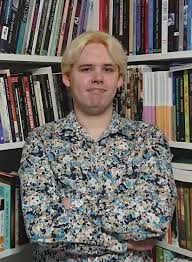
Hugo Ljungbäck, is an accomplished artist, curator, and scholar whose work examines the intersections of queer art, experimental film and video, media archaeology, who saw a lack of attention on queer home movies in the study of film history and aimed to remedy that oversight with his grant project. He gave us a few moments of his time to talk about the project.
Q) You were recently provided with a grant from The Gay & Lesbian Review. What inspired you to focus on queer amateur films and home movies for your project?
I’ve been interested in amateur filmmaking and home movies for quite a while. My parents had a VHS-C camera and shot videos of us while we were growing up, and my own first amateurish attempts at filmmaking were made with that same camera. Being able to turn to this archive two decades later was really impactful to me, and I learned to appreciate the value and history of home moviemaking. This eventually led me to my work with the Association of Moving Image Archivists’ Small Gauge and Amateur Film Committee, and my broader interests in nontheatrical films, found footage filmmaking, and film preservation. But it wasn’t until I stumbled upon François Reichenbach’s early amateur film and home movies, which were recently restored by the Cinémathèque française and made available on their new streaming site at the beginning of the pandemic, that I realized that queer filmmakers, who may not have been able to make films in a professional capacity, or exhibit them publicly—for a multitude of reasons—did make films in private, for themselves. But as I discovered more and more traces of queer amateur filmmaking, I also recognized that this was a largely unwritten chapter of film history, and especially of queer film history—perhaps understandably so, since most of these films were made in private.
Q) You are currently a PhD Student in Cinema and Media Studies at the University of Chicago. What do you think studying the previous depictions of queer life on film can teach us about where we are now?
More than anything, I think these films show that we’ve always been here, and that we’ve managed to persevere, even in the most difficult circumstances. What’s particularly exciting about queer amateur films is that they were made by ourselves, for ourselves, and they reject the stereotypes and negativity that were often present in professional and mainstream filmmaking. This self-representational mode of filmmaking meant that they were empowered to determine and envision their own cinematic futures—and we must continue to do so.
Q) I was curious, as a scholar of film from many eras, what your thoughts are on people using new technology to recover or “improve” old films?
This is actually one of my main research areas and concerns. On the one hand, it’s really exciting that people are suddenly interested in early film, and I think we should make the most of this opportunity to engage with audiences who otherwise wouldn’t care about these kinds of films. On the other hand, I worry that AI is distorting our perception of the past, and irrevocably altering, or at least diluting, the historical record. I think it’s fine to use new technologies to make our film heritage more accessible, but we also need to understand that what we are seeing now is not the same as what audiences saw a century ago.
Q) I saw that you had done many interesting short films. Do you have plans to ever do a longer project?
I’ve been making shorts for about seven years now, all focused on different aspects of being queer. My last three films are a sort of trilogy about coming out as a gay teenager, and all of them are largely autobiographical. It’s a format I find really compelling because you can be concise and to-the-point, as well as experiment with style and form, in a way that you typically can’t with features. That said, I’m currently developing a feature-length documentary, which I’m hoping to complete over the next two or three years.
Q) While doing research for your projects, have there been any films that have been lost to time that you think could have a large impact on current studies?
Film historians and film archivists are doing incredibly important work to recover films that have previously been considered lost, or films no one knew existed to begin with. One prominent recent example is the discovery about five years ago of Something Good—Negro Kiss, a short film from 1898 found by archivist Dino Everett and identified by historian Allyson Nadia Field, which survives as the earliest record of Black intimacy on screen. This discovery received lots of attention precisely because these kinds of images are so rare, and the film was added to the National Film Registry. It’s only one—though perhaps the most visible—example of a recently restored film that challenged our perception of the past, and that provided a glimpse of resistance and persistence—of hope—at a time of rampant anti-Blackness. Reichenbach’s mid-century reels similarly show us that, though they may have had to live in relative secrecy in the face of persecution and ostracization, these gay men were able to carve out their own worlds, indulge in their desires, and lead what seem like fulfilling and happy lives. These discoveries are typically not accidents, but a testament to the persistent work, effort, dedication, and care of unsung archivists, scholars, and filmmakers to preserve our history, and we owe them everything.
Q) Once you finish your PhD, have you decided what your focus is going to be?
I’m hoping to continue my research and filmmaking.
Final four questions–we ask everybody.
Q) When the zombies take over the world, where will you be?
Hiding at a farm in the middle of a Swedish forest, or, even better, on a small boat far off the coast.
Q) What is your favorite fandom?
I’m a big fan of lots of things, but I try to stay away from fandoms as best I can. I have a close friend who keeps me posted on a lot of the fandom drama, and that’s more than enough for me.
Q) What piece of art, be it in the form of music, a book, a film, or picture, do you think people must experience before they die?
I think everyone should experience Cecelia Condit’s short film Annie Lloyd.
Q) Give one fact that most people would not believe about you?
I’m not sure this is really that far-fetched to people who know me, but lately I’ve been very interested in genealogy and my own family history. Building on research that my grandma and other relatives undertook several decades ago, we’ve been able to trace part of our ancestry back to the late seventeenth century. (Those who know me really well also would not be surprised to learn that I’ve created a comprehensive database of said research that now includes well over a thousand distant relatives across a dozen generations.)
 Paper Phoenix ink